Services Provided / Concrete Sealing
SEALING, DENSIFYING, AND DUSTPROOFING
Lithium silicate densifiers, penetrating sealers, and dustproofing for warehouse, distribution, and manufacturing slabs where a full resinous system is not the right spend.
THE DUSTING SLAB PROBLEM
Untreated concrete wears from the surface down. Every pass of a forklift abrades a little more of the soft laitance at the top of the slab, and that material becomes airborne dust that settles on your product, your racking, your equipment, and inside your air handlers. Meanwhile the exposed surface absorbs oil, hydraulic fluid, and moisture, and gets harder to clean every year.
Most facilities respond to this in one of two wrong directions. They live with it and absorb the cleaning cost, the product contamination, and the slow degradation of the slab. Or they price a full resinous floor for a two-hundred-thousand-square-foot warehouse and abandon the project when the number comes back.
Sealing and densifying is the middle answer that gets skipped. It will not give you the chemical resistance or the appearance of a coating. It will harden the wear surface, stop the dusting, make the floor cleanable, and add years of service life at a small fraction of the cost per square foot.
Sealing and densifying is usually the right spend when:
THE PRODUCT FAMILIES
The words get used interchangeably in sales conversations and they should not be. Each does a specific job, and the right answer is often a combination.
THE FOUNDATION
A penetrating chemistry that reacts with free lime in the concrete to form additional hardened material inside the pore structure. It does not sit on the surface, so it cannot peel or wear off. Hardens the wear surface, sharply reduces dusting, and improves abrasion resistance permanently.
Best for: warehouse and plant slabs, dust control, and extending slab life. The usual starting point.
STAIN DEFENSE
Silane and siloxane chemistries that penetrate and reduce absorption of water, oil, and fluid without forming a visible film. Typically applied over a densifier where staining and cleanability are the concern rather than hardness alone.
Best for: oil and fluid exposure, staining concerns, and easier cleaning.
APPEARANCE
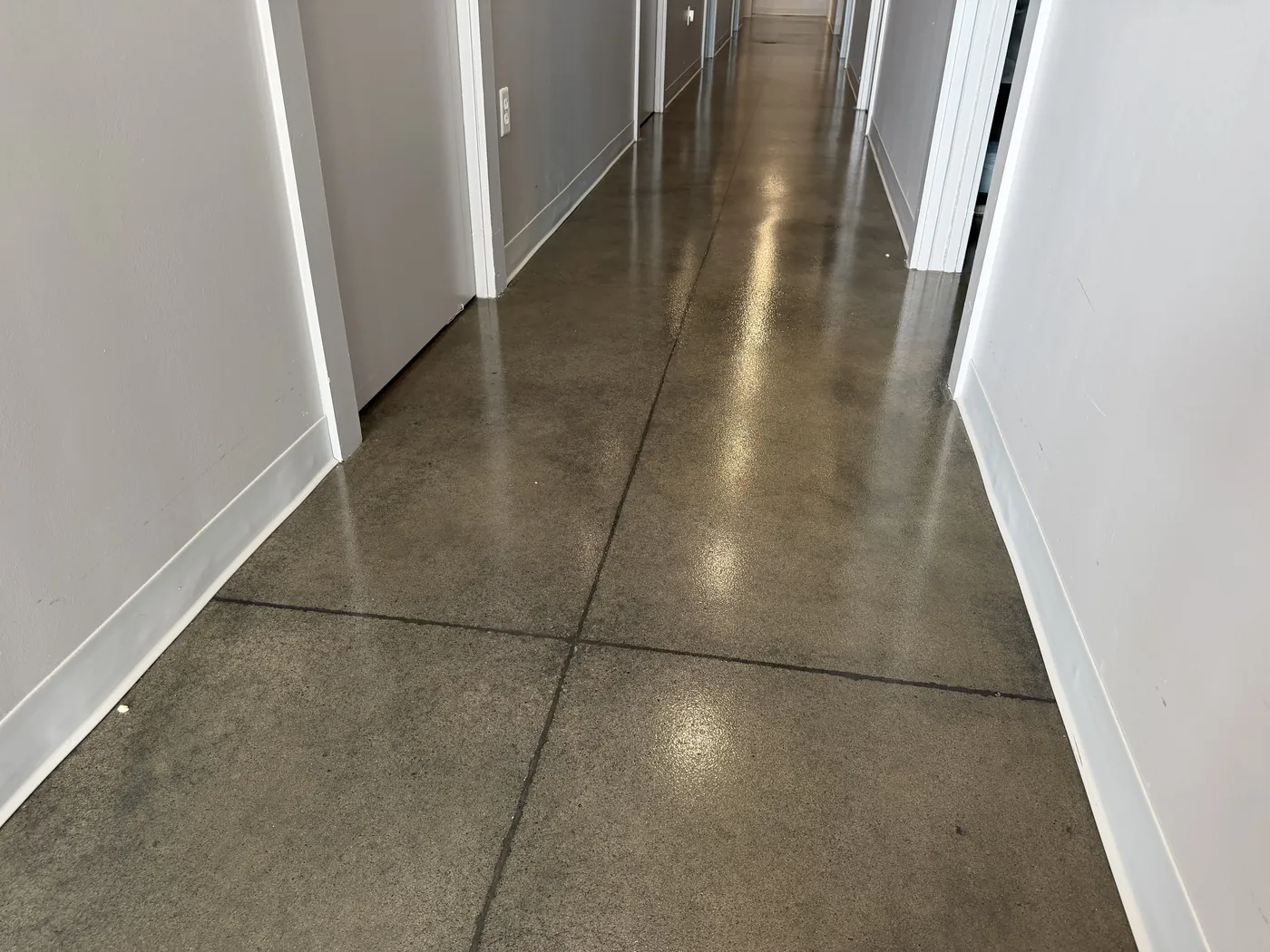
Progressive mechanical grinding and polishing with densifier applied at the correct step, producing a hard, light-reflective, genuinely low-maintenance finish. Costs more than sealing and far less than most resinous systems, with essentially unlimited service life on a sound slab.
KNOW THE LIMIT
Sealers and densifiers do not deliver chemical resistance, thermal shock resistance, or a sanitary seamless surface. If your floor sees aggressive chemistry, hot washdown, or a health inspector, you need a coating or tile, and we will tell you that instead of selling you a sealer that will not do the job.
AN HONEST READ
This is a service we recommend more often than we get asked for, and decline more often than you might expect:
If a densifier is genuinely the right answer for your building, that is what we will quote, even though it is the smallest ticket on our list.
WORKING AROUND YOUR OPERATION
No shot blasting, no odor, no extended cure. In most facilities we work around active operations rather than shutting them down.
MINIMAL DISRUPTION
Densifier application and burnishing move quickly and release back to traffic in hours. We work in sections around racking, staging, and equipment without stopping the building.
OPTION 1
Where aisle access is the constraint rather than cure time, we run the work overnight or across a weekend and hand the floor back before the next shift.
OPTION 2
On very large buildings we phase by zone across quarters so the cost lands across a budget year rather than in a single capital request.
HOW WE WORK
Michael Groff or Colby Coda walks the slab, checks hardness and porosity, looks at what the traffic is actually doing to the surface, and determines whether densifying will solve your problem or whether you are looking at a coating. On a floor this large, being wrong about that is expensive, which is why we look before we quote.
Read about our diagnostic-first processSTART HERE
Tell us the square footage and what the floor is doing. We will walk it and tell you whether sealing solves it, or whether it does not and you need something else.